

 Promotions
Teflon: what it is, whether it's toxic, and which pans are safest

If you've researched Teflon, you've probably come across wildly conflicting opinions: from those who consider it a dangerous material to those who claim it's completely safe. The truth, as is often the case, lies somewhere in between. In this article, we'll explain exactly what Teflon is, its connection to PFOA, whether you should be concerned about your current pans, and what the safest alternatives are today.
What is Teflon?
Teflon is the registered trademark of DuPont for its non-stick coating. Its actual scientific name is PTFE (polytetrafluoroethylene), a synthetic polymer discovered in 1938 that began to be applied to cooking pans from 1961.
What makes PTFE special is its chemical structure: it's one of the most inert materials in existence, meaning that almost no substance adheres to it. This is why it's so effective as a non-stick coating on pans, pots, and griddles.
Important point: When people say "Teflon pan," they're actually saying "PTFE-coated pan." Teflon is a brand name, like Thermomix or Post-it. Many manufacturers produce PTFE coatings without using the Teflon brand.
What is PFOA? Why is it causing alarm?
This is where things get complicated. PFOA (perfluorooctanoic acid), also known as C-8, is not Teflon itself, but a chemical substance that was used as an aid in the PTFE manufacturing process.
PFOA has worrying characteristics:
- It is extremely persistent in the environment and in the body — it does not degrade.
- It has been found in the blood of people and animals all over the world.
- The International Agency for Research on Cancer (IARC) has classified it as a possible carcinogen.
- The U.S. Environmental Protection Agency (EPA) also declares it a probable carcinogen.
- In 2005, DuPont was fined $16.5 million for concealing evidence of its harmful effects.
- The European Union banned its use in kitchen utensils in 2020.
The historical confusion between PFOA and PTFE led many people to believe that "Teflon is toxic," when in reality the problem was the PFOA used in its manufacture.
Is Teflon toxic? The honest answer

PTFE itself It is non-toxic at normal cooking temperatures. It is a chemically inert material that does not react with food. If a small fragment breaks off from a scratched pan and you ingest it, your body will expel it without absorbing it.
However, there are two situations in which PTFE can become problematic:
PTFE begins to degrade at temperatures above 260°C and can release irritating fumes. Above 350°C, the degradation is significant. This rarely occurs in normal household cooking, but it can happen if you heat an empty pan over high heat for several minutes.
Before that date, many manufacturers used PFOA in their production processes. Although PFOA didn't remain on the surface of the pan, workers and the surrounding factory environment were exposed. Since 2013, major brands have eliminated PFOA from their processes. Since 2020, it has been banned in the EU.
Conclusion: A modern, PFOA-free non-stick frying pan, used at normal temperatures and in good condition, does not pose a health risk.
Should I throw away my scratched Teflon pans?
It's the most frequently asked question. The answer is nuanced:
PTFE is not toxic, even if small particles are ingested. There is no urgent health reason to throw them away.
A badly scratched pan has lost its non-stick properties. You need more oil, food sticks, and the cooking experience suffers considerably.
If the pan is more than 10 years old (possibly made with PFOA), if it is very deteriorated, or if you regularly cook at very high heat, it makes sense to replace it.
The rule of thumb is simple: If the pan has lost its non-stick coating or is peeling in more than one area, it's time to replace it., not so much because of toxicity but because it no longer fulfills its function.
Cómo limpiar una sartén antiadherente correctamente

Poor maintenance is the main cause of premature deterioration of non-stick pans. These are the most common mistakes and how to avoid them:
What you should never do:
- Use metal or abrasive scouring pads
- Put it in the dishwasher if the manufacturer does not expressly indicate so.
- Cooking with metal utensils (use silicone or wood)
- Heat the empty pan over high heat
- Run the hot pan under cold water (thermal shock can damage the coating)
How to clean it properly:
- Let it cool down before cleaning it
- Use warm water with a few drops of dish soap and a soft sponge
- For stuck-on bits, fill the pan with water and bring it to a gentle boil for 2-3 minutes — the bits will loosen on their own.
- Dry it well before storing it
- If you stack it with other pans, place a cloth or paper between them to protect the coating.
Can I salvage a burnt non-stick pan? It depends on the degree of damage. If the coating simply has charred residue but is otherwise intact, the boiling water trick usually works. If the coating is peeling or deeply scratched, there's no way to salvage it: it's time to replace it.
What alternatives are there to Teflon pans?
The current market offers several options for those who prefer to move away from PTFE:
It's the alternative that combines the advantages of non-stick coatings—easy cleaning, less oil needed—with the complete absence of PFOA and PTFE. Forged aluminum is more durable than stamped aluminum, distributes heat evenly, and withstands daily use better. Castey's Durion® coating, for example, is made without PFOA, PTFE, or heavy metals.
Excellent heat retention, very durable, but heavy and requires maintenance (periodic curing). Not practical for everyday use for everyone.
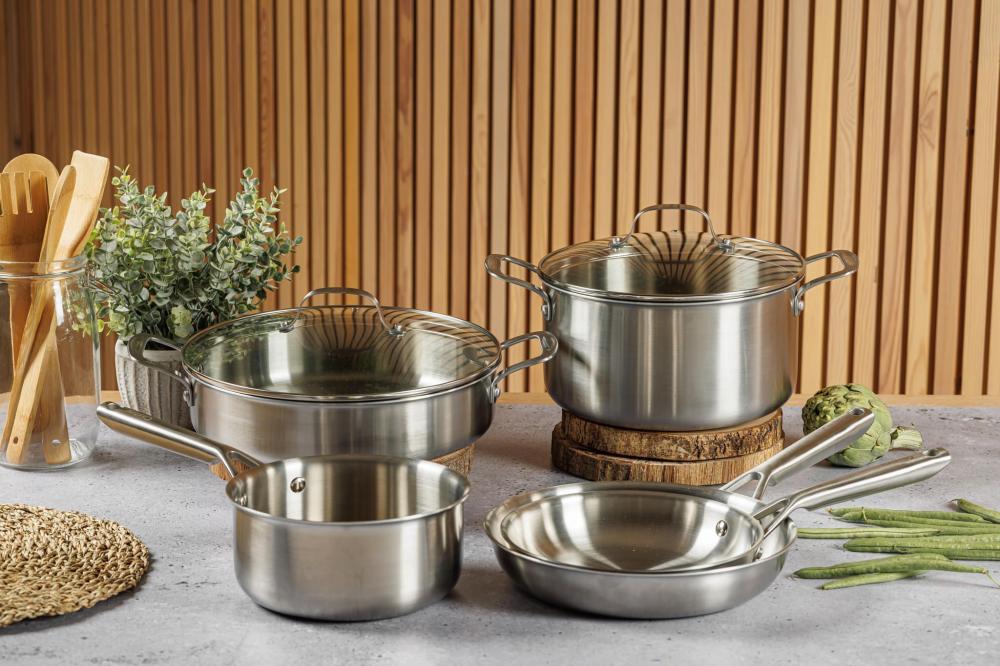
Without any coating, completely inert. Requires more technique to prevent food from sticking and more oil. Ideal for searing meats.
A popular alternative, but ceramic coatings tend to be less durable than PTFE and lose their non-stick properties sooner.
Castey pans: forged aluminum without PFOA or PTFE
At Castey we have been manufacturing kitchen utensils in the Basque Country for over 500 years, and we were one of the first manufacturers to eliminate PFOA from our production processes.
Our pans use Durion®, A high-resistance non-stick coating developed without PFOA, PTFE, and heavy metals. It is designed to withstand intensive daily use without premature deterioration.
The line Fundix It also incorporates a detachable handle system, which makes the pan easier to clean, store and use both on the stovetop and in the oven.
Featured products from the Fundix range


Frying pans
Unsure which frying pan to choose? Write to us or check out our guide on the different types of non-stick coatings.